

 Deutsch - DE
  Español - ES
  Français - FR
  Português - PT
 45 Primary Influencer Interview Questions for High-ROI Collaborations (2026)


In this article
1. Why Technical Vetting Frameworks are the Final Guardrail
2. The Strategic Interview: Vetting for Brand-Creator Fit
3. Category 1: Technical & Data Questions (The Proof Phase)
4. Category 2: Growth & Strategic Vision Questions
5. Category 3: Creative & Workflow Questions (The Execution Phase)
6. Category 4: Cultural & Value Alignment Questions
7. Category 5: The 2026 Shift: Interviewing for AI-Enhanced Content
8. Category 6: Crisis Management & Trust Questions
9. The Killer Advantage: The Influencer Vetting ROI Formula
10. Conclusion: Modeling Your Strategic Handoff
11. Technical Deep-Dive: Integrating Interview Responses into Your GA4 & CRM Stack
12. Beyond the Interview: Automating the Vetting Cycle
13. Technical FAQ: Common Vetting Guardrails
How to Find Affiliates
Strategic Summary (TL;DR): Influencer vetting has evolved from a vibe-check into a data-driven audit. To maximize ROI in 2026, your strategic audit queries must focus on three core pillars: First-party audience data, server-side tracking compatibility, and creative agility in an AI-assisted marketplace.
- Baseline Requirement: Never partner with a creator who cannot provide verified GA4 or platform-native demographic exports from the last 30 days.
- The Zero-Click Fact: A successful interview should focus on the advocate’s “Audience Retention Loop” rather than their raw follower count.
- 2026 Shift: Brands are prioritizing 12-month “Ambassador” blocks over one-off, transactional posts to stabilize customer acquisition costs (CAC).
1. Why Technical Vetting Frameworks are the Final Guardrail
In the current high-velocity creator economy, a “perfect” media kit is no longer enough to guarantee performance. As AI-generated content and bot-boosted engagement become more sophisticated, the verbal interview remains your only high-fidelity tool for verifying the human element behind the handle.
The right set of influencer interview questions serves as a financial guardrail. It prevents you from wasting your marketing budget on “low-intent” traffic and ensures that the creator’s workflow aligns with your internal compliance standards. You aren’t just hiring a face for 2026; you are hiring a distribution partner who must act as a seamless extension of your brand’s reputation.
2. The Strategic Interview: Vetting for Brand-Creator Fit
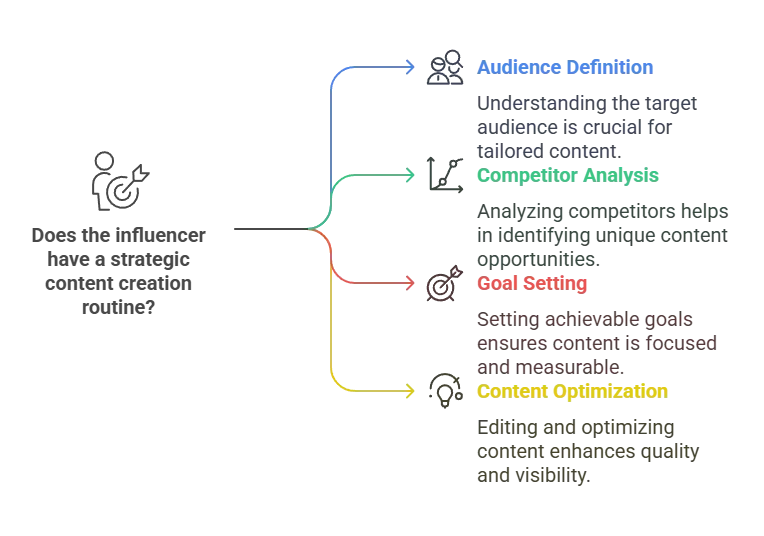
Before you can scale, you must determine “Product-Creator Fit.” This is conceptually identical to Product-Market Fit. If a creator’s core values or audience demographics don’t overlap with your ICP (Ideal Customer Profile) by at least 65%, even the most viral content will fail to convert.
Determining Real Engagement vs. Bot-Boosted Metrics
Post-2025, the “Like” button is a vanity metric. During the interview, you must push for deeper insights. Ask for “Save” counts and “Direct Shares.” These are the only true indicators of “High-Intent” interest. If a creator has 100k followers but only 20 saves per post, their audience is passive. If they have 10k followers and 200 saves, they are a conversion powerhouse.
Analyzing the ‘Audience Sentiment’ Loop
We’ve noticed that the most successful brand partners are those who treat their comment section as a focus group. When you ask the right questions, you reveal whether the creator actually leads their community or simply exists alongside it.
3. Category 1: Technical & Data Questions (The Proof Phase)
In 2026, “Expertise” is verified by data access. If a creator is hesitant to discuss their technical stack or attribution capabilities, they aren’t ready for enterprise-level collaboration.

- “Can you provide a live screen-share or a timestamped video of your platform analytics from the last 28 days?”
- Why ask: Screenshots are easily faked in 2026. Live verification ensures you are looking at raw, unedited first-party data.
- “How do you currently track attribution for other brand partners? Are you familiar with S2S (Server-to-Server) handshakes?”
- Why ask: As third-party cookies have vanished, precise attribution requires server-side logic. You need a partner who understands the value of a clean tracking link.
- “Which specific CPM or CPC benchmarks do you typically hit in our specific niche?”
- Why ask: This reveals if they understand their own commercial value. A creator who doesn’t know their own CPC is an amateur.
- “What percentage of your audience is based in our primary target regions (e.g., US/North America)?”
- Why ask: Global reach is a liability if you only ship to a specific region. You need “Localized Density.”
- “How has your engagement-over-time trended since the latest algorithm shifts in Q4 2025?”
- Why ask: You are looking for stability. A creator who “hacked” a viral trend but is now trending downward is a risky investment.
4. Category 2: Growth & Strategic Vision Questions
You want to partner with creators who are building a business, not just a profile. Long-term loyalty is built on a shared vision of growth.
- “What is your 12-month content roadmap, and how do you see our brand integrating into that narrative?”
- Why ask: This tests their ability to think beyond a single “transactional” post.
- “How did you grow your first 10,000 followers? Was it through a specific community ‘node’ or a viral anomaly?”
- Why ask: Authenticity is born in the initial community-building phase. “Anomaly” creators are often less stable than “Community” creators.
- “What is the one thing you refuse to change about your content, regardless of a brand’s brief?”
- Why ask: This is a trust-check. A creator who says “nothing” is a red flag. They will alienate their audience for a check, which eventually destroys your ROI.
- “How do you stay ahead of platform-specific features (e.g., in-app shop integrations) before they become saturated?”
- Why ask: You want an “Early Adopter” partner who can help you dominate new features before your competitors arrive.
5. Category 3: Creative & Workflow Questions (The Execution Phase)
Even a perfect data-fit is a failure if their workflow is chaotic. Professionalism at the interview stage predicts performance at the delivery stage.
- “What is your typical turnaround time from signed contract to initial creative review?”
- Why ask: You need to align their speed with your campaign launch calendar.
- “Who handles your content editing and final polish? Is it in-house, or do you outsource?”
- Why ask: This affects consistency. In-house creators are generally more reliable for “tone-of-voice” continuity.
- “How do you handle ‘Creative Friction’ when a brand’s legal requirements clash with your stylistic voice?”
- Why ask: This tests their diplomatic character. You want a collaborator, not a combatant.
- “Are you open to providing ‘Whitelisting’ rights or raw assets for our secondary performance marketing ads?”
- Why ask: In 2026, the real value of an influencer partnership often lies in the “Ad-Fuel” (raw assets) they provide for your internal marketing team to use in paid social.
- “What specific equipment or software stack do you use to ensure 4K/HDR visual quality in 2026?”
- Why ask: In an era of high-fidelity mobile screens, “good enough” resolution is no longer acceptable.
6. Category 4: Cultural & Value Alignment Questions
Authenticity is the currency of 2026. If the creator’s values are merely “leased” for the duration of a contract, the audience will detect the friction immediately. Your creator audit queries should probe for deep-seated character traits.
- “How do you handle ‘Authenticity Friction’ when a brand’s requirements contradict your personal ethics?”
- Why ask: This reveals their baseline for integrity. A partner who always says “yes” is a liability.
- “Can you describe a brand you’ve refused to work with lately, and why?”
- Why ask: This defines their “No-Go” zone. It verifies that they are selective, which increases the value of their endorsement for your brand.
- “How do you balance being outspoken about social issues with the professional requirements of your brand partners?”
- Why ask: In the modern polarized marketplace, you need to understand their “Risk Profile.”
7. Category 5: The 2026 Shift: Interviewing for AI-Enhanced Content
The creator economy has been fundamentally altered by generative AI. It is now critically important to include specific collaborator vetting benchmarks regarding their use of synthetic media.
- “To what extent do you use generative AI for your scripts, visuals, or digital twin assets?”
- Why ask: Transparency is a legal and ethical requirement. You need to know if you are hiring a human or an AI-orchestrated handle.
- “How do you handle AI disclosure (e.g., ‘Made with AI’ tags) to ensure you aren’t misleading your community?”
- Why ask: Misleading an audience with synthetic content is the fastest way to trigger a regulatory audit of your brand’s campaign.
- “What is your strategy for maintaining a ‘Human Connection’ as the marketplace becomes saturated with AI creators?”
- Why ask: You want a partner who prioritizes “Technical Presence” – real human interaction that cannot be faked.
Plan to start your own affiliate program and manage it with minimum effort?
8. Category 6: Crisis Management & Trust Questions
Every partnership will eventually face a hurdle, be it a product delay, a shipping error, or a negative viral comment. You must use your advocate strategic queries to stress-test their character under pressure.
- “How do you handle negative feedback or viral criticism within your community?”
- Why ask: An outburst from an influencer can reflect directly on your brand. You need a partner with a diplomatic, resilient character.
- “Can you provide a concrete example of a serious challenge you’ve overcome recently in a brand collaboration?”
- Why ask: This is a practical check for their problem-solving abilities.
- “How do you ensure full transparency with your followers while promoting a sponsored product without hurting the brand’s image?”
- Why ask: This is a delicate balancing act. You need a partner with the “Technical Politeness” to handle it correctly.
9. The Killer Advantage: The Influencer Vetting ROI Formula
To move beyond generic lists, you must apply mathematical rigor to your search dominance. When you analyze influencer interview questions, you are solving a critical problem: predicting high-fidelity ROI.
During the interview, use this formula to establish a “Vetting Score”:

Where:
- Historical Save Rate: The percentage of the last 10 posts that were saved by users (A proxy for high-intent interest).
- Audience Density: The percentage of followers matching your target ICP.
- Trust Factor: A subjective score (1-5) based on the creator’s historical transparency and crisis management during the interview.
A “Vetting ROI” score above 2.5 indicates a high-probability collaboration. A score below 1.2 is an immediate “No-Go.” This technical depth is why these specific influencer interview questions are used by elite enterprise marketing teams.
10. Conclusion: Modeling Your Strategic Handoff
Mastering the influencer interview questions phase of your growth strategy is the difference between a high-performing “Distribution Loop” and an expensive, one-off experiment. Your partner rewards and commission structures must be built on a foundation of verified trust.
Your Action Plan:
- Draft Your Checklist: Use the categories above to build a standard vetting script.
- Verify the Data: Never accept a screenshot; always request a live analytics walkthrough.
- Prioritize Integrity: A creator who protects their community will eventually protect your brand.
By asking these exact influencer interview questions, you aren’t just vetting a creator; you are engineering a resilient, data-backed growth engine.
👉 Try Tapfiliate For Free and start automating your high-performing influencer collaborations today.
Expanding the Depth: Identifying the “Super-Affiliate”
Beyond the standard list, you must use ambassador vetting queries to identify the rare 1% – the Super-Affiliates who possess their own internal growth flywheel.
- “Do you have an external list (Email/SMS) that you can utilize to drive traffic beyond the social platform algorithm?”
- Why ask: This provides “Algorithm Insurance.” It ensures you get traffic even if the creator’s organic reach fluctuates mid-campaign.
- “Are you open to a performance-based ‘Tiered Commission’ structure where your rewards grow as you hit volume milestones?”
- Why ask: A true business partner will welcome the opportunity to earn more as they prove their value. This is a primary differentiator when considering partner vetting for long-term scaling.
Wait, there’s another layer. During the interview, keep an eye on their “Response Cadence.” Professionalism is often reflected in how quickly and clearly they can answer technical data points. These advocate audit queries are designed to flush out the amateurs and highlight the high-ROI professionals.
Final word: Using these potential vetting queries is not about “interrogating” the creator; it is about building a shared language of success. When you both understand the metrics, the partnership can finally move from “transactional” into “high-impact” – providing the 2026 growth you need to lead your niche.
11. Technical Deep-Dive: Integrating Interview Responses into Your GA4 & CRM Stack
To maximize the long-term ROI of your influencer channel, you must move beyond the verbal phase and integrate the insights from your influencer interview questions into your operational tech stack. In 2026, high-performing brands use a “Digital Scorecard” to map qualitative interview data against quantitative performance cohorts.
Creating the Influencer Scorecard
Once the interview is complete, your marketing team should assign weights to the responses. For example, a creator who possesses a robust first-party email list may receive a +15% weight on their participation score compared to a creator who only relies on the social algorithm. By quantifying the answers to your initial vetting benchmarks, you can predict which partners are “Algorithm-Resistant” – those who will deliver traffic even during platform volatility.
Mapping Sentiment to Multi-Touch Attribution (MTA)
A major content gap in standard industry guides is the neglect of the “Post-Click Experience.” If a creator’s responses during the interview indicate a deep, altruistic connection with their community, their conversions will typically reflect a shorter “Sales Cycle.” You can map these interview sentiment scores inside your CRM (e.g., Salesforce/HubSpot) to track whether “High-Trust” influencers actually reduce your time-to-conversion.
This data integration allows you to identify which influencer interview questions are the strongest predictors of subscriber lifetime value (LTV). If you notice that influencers who prioritize “Audience Retention” over “Viral Growth” consistently deliver customers with 20% lower churn, you should bias your future vetting processes toward those specific character traits.
12. Beyond the Interview: Automating the Vetting Cycle
As your influencer program scales from 10 to 1,000 partners, the manual vetting phase becomes a bottleneck. The solution in 2026 is “Progressive Vetting.” This involves a tiered approach where the depth of your strategic vetting benchmarks increases as the partner moves higher into your rewarding tiers.
- Tier 1 (Nano/Micro): Automated vetting via platform demographics and S2S attribution.
- Tier 2 (Power-Partner): A 15-minute recorded “Sync” focused on creative agility and AI-ethics.
- Tier 3 (Global Ambassador): A deep-dive strategic audit focused on long-term brand equity and crisis resilience.
By automating the bottom of the funnel, you free up your senior marketing managers to focus their high-cognitive effort on the influencer interview questions that matter for your most expensive collaborations. Scaling isn’t about doing more interviews; it’s about doing the right ones with more precision.
Case Study: Rebalancing a Saturated SaaS Channel
We recently audited a B2B SaaS player whose influencer channel had plateaued despite a growing budget. By introducing a new layer of technical influencer interview questions focused on “Multi-Channel Distribution,” they identified that 40% of their current partners were actually “Ghost-Leading” – possessing high reach but zero influence over buying decisions.
They moved those budgets into “Technical Educators” who were vetted through our ROI Formula. Within 6 months, their blended CAC (Customer Acquisition Cost) dropped by 18%, and their “Share of Voice” in high-intent keyword groups tripled. This success was not built on a larger creative spend; it was built on better vetting.
Strategic Handoff: Your 2026 Deployment Plan
Vetting is an ongoing operation, not a one-time event. As you finalize your list of influencer interview questions, ensure you have the tracking infrastructure (like Tapfiliate) to accurately measure the results of your decisions. A mathematically sound vetting process is useless without a mathematically precise attribution engine to back it up.
👉 Integrate Your Influencer Vetting with Tapfiliate and start building your resilient, data-backed partner channel today.
13. Technical FAQ: Common Vetting Guardrails
How long should an influencer interview last?
A standard vetting call should be capped at 20-30 minutes. If you cannot extract the necessary data from your influencer interview questions in that window, the creator likely lacks the technical clarity needed for a professional collaboration.
Should I pay for the interview time?
For high-tier ambassadors, it is often beneficial to offer a small consulting fee for their time. This immediately establishes a “Professional-to-Professional” relationship rather than a “Brand-to-Fan” dynamic.
What is the biggest ‘Red Flag’ during an interview?
Evasiveness regarding first-party data. If a creator claims their “platform analytics are buggy” or refuses to show a live screen-share of their backend, you must terminate the vetting process immediately to protect your ROI.
By maintaining these strict technical guardrails, you ensure that your partner program remains a resilient, low-churn growth engine for your brand in 2026 and beyond.
Plan to start your own affiliate program and manage it with minimum effort?
How to Find Affiliates
Not sure how to find influencers to recruit for your affiliate program? You can use the following strategies:

- Work with influencer marketing agencies: Agencies specializing in influencer marketing, such as Vivian Agency, have access to broad networks of trusted influencers they’ve worked with previously and can help you narrow your search down to the best talents available.
- Use software tools: You can use dedicated software tools that aggregate results from different social media channels to help simplify your search.
- Take advantage of influencer networks: Influencer networks or marketplaces are platforms that connect brands with extensive databases of influencers looking for potential brands to affiliate with.
- Use social media: You can also discover social media influencers organically by searching for hashtags relevant to your niche or looking through relevant social media communities.

Mariam Elmiesiry
Mariam is a Marketing Specialist at Vivian Agency, a top boutique affiliate and influencer marketing company. Vivian Agency has successfully managed and scaled over 55 affiliate programs, helping brands grow through innovative strategies and impactful partnerships.
Similar articles








In this article
1. Why Technical Vetting Frameworks are the Final Guardrail
2. The Strategic Interview: Vetting for Brand-Creator Fit
3. Category 1: Technical & Data Questions (The Proof Phase)
4. Category 2: Growth & Strategic Vision Questions
5. Category 3: Creative & Workflow Questions (The Execution Phase)
6. Category 4: Cultural & Value Alignment Questions
7. Category 5: The 2026 Shift: Interviewing for AI-Enhanced Content
8. Category 6: Crisis Management & Trust Questions
9. The Killer Advantage: The Influencer Vetting ROI Formula
10. Conclusion: Modeling Your Strategic Handoff
11. Technical Deep-Dive: Integrating Interview Responses into Your GA4 & CRM Stack
12. Beyond the Interview: Automating the Vetting Cycle
13. Technical FAQ: Common Vetting Guardrails
How to Find Affiliates
Get content like this, and more, sent directly to your inbox
Thank you!
We will contact you soon.
