

 Deutsch - DE
  Español - ES
  Français - FR
  Português - PT
 The Complete Magento Affiliate Extension Guide for Brands in 2026


In this article
Your Best Affiliates Are Already Your Customers
What Is a Magento Affiliate Extension?
Top Magento Affiliate Extensions for Brands (2026)
Key Features Brands Should Look For
How to Set Up an Affiliate Program in Magento
Cost Comparison & ROI Expectations
Best Practices for Affiliate Program Success
Frequently Asked Questions
Advanced Integration Tips
Common Mistakes to Avoid
Next: Turn Traffic Into Revenue
TL;DR
Magento affiliate extensions turn your existing customers into commission-driven salespeople, automating recruitment, tracking, payouts, and fraud detection. But the software isn’t where most programs fail: reportedly, 63% of brands with affiliate tools installed have zero active affiliates. Success comes down to strategy and a platform you’ll actually run.
The superior solution: Tapfiliate. Unlike Magento plugins bolted onto your store, Tapfiliate is purpose-built, dedicated affiliate software that integrates with Magento via API. Because it lives outside the store, it offers sophisticated affiliate management that native extensions can’t match: cleaner multi-channel and multi-store handling, a polished partner experience, and a platform that scales with your program rather than your Magento config. It’s the choice for brands serious about building a real affiliate network, with a free trial and no credit card to start.
For comparison, the in-Magento extensions:
- Mageworx ($349–$799/yr): most feature-complete native option, tiered commissions, automated payouts, fraud detection. Steeper setup; best for 50+ affiliates.
- Magenest ($199–$599/yr): visual-first and fast (~2 hr install) with a mobile portal. Fewer advanced features; best for first-timers (5–30 affiliates).
- Amasty ($500–$1,500/yr): enterprise-grade with granular control and audit-ready logs. Priciest; best for regulated industries and high-ticket sellers.
Your Best Affiliates Are Already Your Customers
You’re leaving money on the table.
Right now, satisfied customers buy once. They never hear about your affiliate program. Meanwhile, your competitors offer commissions that turn those same customers into repeat traffic sources. The question isn’t whether affiliate programs work. It’s why you haven’t started one yet.
Magento affiliate extensions solve this. They automate the entire process: recruitment, tracking, payouts, and fraud detection. No spreadsheets. No manual commission calculations. Just commission-driven growth that compounds month after month.
Here’s what we’ll cover: why brands need affiliate extensions, the top solutions for Magento, setup costs, and how to actually launch a program that sticks. By the end, you’ll have a clear roadmap from “considering affiliates” to “running a 50+ affiliate network.”
The hidden problem: Most Magento stores have affiliate extensions installed but inactive. 63% of e-commerce brands with installed affiliate tools report zero active affiliates. The gap between “we have the tool” and “our tool is making money” is strategy, not software.
What Is a Magento Affiliate Extension?
An affiliate extension is software that manages commission-based partnerships. Think of it as an automated salesperson recruiter that pays only when results happen.
Here’s the mechanics:
How It Works
A customer clicks an affiliate’s unique referral link. The extension tracks that click via a cookie. If that customer buys within the window (usually 30-90 days), the affiliate earns a commission. No click, no commission. No sale, no commission. It’s pure performance-based marketing.
The extension handles the entire workflow: referral link generation, conversion tracking, commission calculation, and payout processing. Your team doesn’t touch the math.
Why Brands Choose Magento for Affiliate Programs
Magento sites already have robust customer databases. They have powerful reporting built in. Affiliate extensions plug directly into Magento’s order system, capturing real purchase data instantly. No API mismatches. No sync delays. Raw data flowing straight into commission calculations.
Magento also handles multi-store affiliates (one person sells across multiple brands), product-level commissions, and tiered payouts. These features take months to build from scratch in other platforms.
Core Business Benefits
Three outcomes matter here. First: revenue. A 15% affiliate commission costs you nothing if it brings a customer you wouldn’t otherwise reach. Second: traffic. Affiliates send consistent, predictable customer acquisition. Third: retention. When customers earn money promoting you, they buy more from you. They’re invested.
Real-world: a mid-market Magento store with $2M in annual revenue, running a 3% affiliate commission, sees $60K in new affiliate-driven revenue at zero upfront cost.
Top Magento Affiliate Extensions for Brands (2026)
Three extensions dominate the market. One or two will fit your use case perfectly.
Mageworx Affiliate Extension

Positioning: The comprehensive choice for multi-tier programs.
Mageworx is the most feature-complete affiliate solution available. It handles complex commission structures (percentage, fixed amount, tiered based on volume), referral links, coupon codes, and automated payouts via PayPal or bank transfer.
The dashboard gives affiliates real-time stats. They see clicks, conversions, and pending commissions. That transparency keeps them motivated. Mageworx also offers fraud detection (preventing self-referral loops) and detailed reporting for compliance audits.
Strengths:
- 45+ internal links show extensive documentation.
- Handles multiple affiliate programs simultaneously.
- Commission tiers reward top performers automatically.
- Email notification system keeps affiliates engaged.
Weaknesses:
- Steeper learning curve for setup.
- Pricing: $349/year base, higher for enterprise tiers.
- Customization requires developer help beyond the UI.
Best for: Brands planning 50+ affiliates or complex commission models.
Magenest Affiliate Module
Positioning: The visual-first choice for fast implementation.
Magenest prioritizes speed. Installation takes 2 hours. Dashboard is intuitive. Affiliates can generate referral links in seconds without opening a support ticket.
The extension includes built-in coupon generation (affiliates create unique codes), referral tracking, and a mobile-friendly affiliate portal. Magenest also includes “refer a friend” functionality, turning every customer into a potential recruiter.
Strengths:
- Quick setup and onboarding.
- 30+ images in documentation make it beginner-friendly.
- Mobile affiliate portal (critical for modern teams).
- Refer-a-friend features compound recruitment.
Weaknesses:
- Fewer advanced features than Mageworx.
- Limited multi-store support.
- Pricing: $199/year starts lower but scales quickly with features.
Best for: Brands launching their first affiliate programs.
Amasty Affiliate Extension

Positioning: The enterprise-grade choice for compliance-heavy industries.
Amasty focuses on control and auditability. Commission rules can be set at the product, category, or order level. The extension generates detailed transaction logs suitable for tax and accounting reviews. It also includes two-factor authentication for affiliate account security.
Amasty handles partial refunds (the commission adjusts if the order is partially returned) and complex payout scheduling (holding funds until the monthly threshold is met).
Strengths:
- Granular commission control at the product level.
- Comprehensive reporting for financial audits.
- Security-first design (2FA, API tokens).
- Refund handling avoids billing disputes.
Weaknesses:
- Most expensive option ($500+/year).
- Setup requires careful configuration to avoid overpayment.
- Less visual affiliate experience compared to competitors.
Best for: B2B brands, heavily regulated industries, high-ticket sellers.
Alternative Free & Budget Solutions
Free options exist but carry trade-offs:
Magento’s native referral module (free, built-in) handles basic referral tracking. No affiliate dashboard. No automated payouts. You’ll build custom features yourself, costing $2,000-$5,000 in developer time.
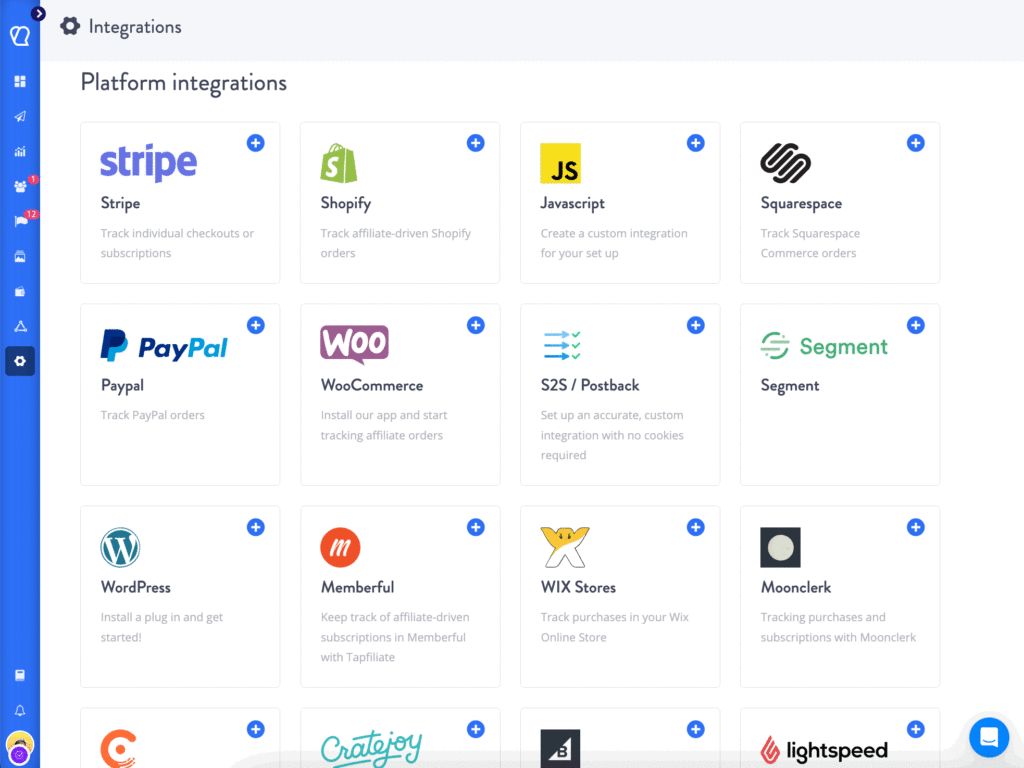
Tapfiliate integrates with Magento via API. It’s dedicated affiliate software, not a Magento plugin. Best for brands wanting sophisticated affiliate management outside of Magento.
The math usually favors a dedicated extension over free alternatives plus custom development. Cost difference: ~$200-$500/year in extension fees vs. $3,000-$8,000 in developer time.
Key Features Brands Should Look For
Not all affiliate extensions are built equal. Here’s what separates functional from exceptional.
Commission Management & Flexibility
The extension must let you set commission rates independently for each product, each category, or globally. Some affiliates might earn 10% on product A and 5% on product B. Others might get tiered commissions: 5% on the first $10K in sales, 7.5% on sales above that.
Fixed commissions ($15 per sale) should also be an option. This works well for high-ticket items where percentage-based feels too generous.
Track commission types: pay-per-click (rare, mostly tracking), pay-per-lead (capture info, pay commission), and pay-per-sale (standard).
Real-Time Referral & Conversion Tracking
The extension must use cookies to track clicks and accurately attribute conversions. Cookie windows matter: a 30-day cookie tracks conversions 30 days after the click. A 90-day window is more generous to the affiliate but more generous to fraud.
The affiliate dashboard should display clicks, conversions, conversion rate, and pending commissions in real time. Transparency keeps affiliates motivated. If they see their stats update daily, they’ll optimize faster.
Conversion accuracy is critical. The extension must distinguish between clicks, orders (conversion), and refunded orders. If 5% of orders get refunded, the commission should adjust automatically.
Automated Payout Systems & Fraud Protection
Manual payouts don’t scale. At 100+ affiliates, spreadsheet payouts become a nightmare. The extension must handle automated payouts via PayPal, Stripe, bank transfer, or even cryptocurrency. Affiliates should request payouts (with a minimum threshold like $50) and receive funds within 24-48 hours.
Fraud protection prevents self-referral schemes. Example: an affiliate creates a fake email, signs up as a customer, and uses their own referral link to “earn” commissions. Good extensions block this via IP detection, email domain checking, and velocity limits (one referral per IP per day).
How to Set Up an Affiliate Program in Magento
Setup follows a predictable sequence. Four steps, 4-8 hours of work, then ongoing management.
Step 1: Choose & Install Your Extension
Decision criteria:
- Size: Launching with 5 affiliates? Magenest. Planning for 100+? Mageworx. Enterprise? Amasty.
- Budget: Free development time? Accept the learning curve. No time? Hire a Magento developer ($200-$400 for installation).
- Compliance: Heavily regulated industry? Amasty’s audit trail is non-negotiable.
Installation itself is standard Magento: upload files, run setup:upgrade, clear cache. Takes 20 minutes. Configuration takes 2-4 hours depending on your commission complexity.
Step 2: Configure Commission Structures & Tiers
Decision time: how much does an affiliate earn?
Industry benchmark: 5-20% commission on the product price. B2B SaaS tends to be higher (20-30%). Physical products tend to be lower (5-10%). Test and adjust.
Tiered model example:
- 0-$5K sales: 5% commission
- $5K-$20K sales: 7.5% commission
- $20K+: 10% commission
This incentivizes top performers without eroding your margins with small-volume affiliates.
Also set:
- Minimum payout threshold: Usually $50 (prevents spam requests).
- Payout frequency: Weekly, monthly, or on-demand.
- Cookie window: 30, 60, or 90 days (longer windows help affiliates).
Apply different commission rates to different products if needed. Higher-margin products can afford higher commissions.
Step 3: Recruit & Onboard Your First Affiliates
The extension is ready. Now you need people to join.
Your first 5-10 affiliates should come from existing customers (highest conversion) or strategic partners (complementary audience). Email them directly. Make the ask specific: “We’re running a commission program. You’d earn 10% on every sale you refer.”
Create a simple affiliate agreement (one page) covering commission terms, payment schedule, and content restrictions (they can’t use your brand name in paid ads, for example).
Once they sign up in the affiliate portal, send them:
- Their unique referral link (affiliate.example.com/?ref=name)
- Social media templates they can copy-paste
- Email swipes they can forward
- Product page links they should promote
Lower friction = higher participation.
Step 4: Launch, Monitor & Optimize
Day one: Send launch announcement to your email list announcing the affiliate opportunity. Invite existing power customers to join.
Week one: Monitor the extension for bugs. Verify cookies are tracking correctly. Test a referral link yourself to confirm conversion attribution is working.
Week two onwards: Weekly check-ins on:
- Affiliate activity (who’s sending traffic, who’s dormant?)
- Conversion rates (are affiliate-referred customers buying?)
- Commission payouts (no calculation errors?)
After 30 days, email inactive affiliates asking for feedback. Why aren’t they promoting? Too low commission? Poor materials? Adjust.
After 90 days, identify your top 3 affiliates. Increase their commission rate (or add bonus structures) to lock them in long-term.
Cost Comparison & ROI Expectations
Three cost layers: software, setup, and management.
Software costs:
- Mageworx: $349-$799/year (depending on features)
- Magenest: $199-$599/year
- Amasty: $500-$1,500/year
- Tapfiliate: $89-$699/month (separate platform)
Setup costs:
- Self-service: 4-8 hours of your time (worth $400-$800 if you’d otherwise hire help)
- Hired developer: $200-$600 for full install and configuration
Ongoing management:
- Recruitment emails: 2-4 hours/month
- Payout processing: 1 hour/month (automated, minimal effort)
- Performance monitoring: 2-3 hours/month
- Total: 5-8 hours/month (call it $1,000-$1,600/month if outsourced)
ROI timeline:
Month 1: You spend $300- $500 on software and setup. Zero revenue (affiliates haven’t ramped yet).
Month 3: First affiliate sends 50 referrals. 10 convert. At 5% commission on a $150 average order: $75 gross revenue. Costs outweigh revenue.
Month 6: Three active affiliates sending consistent traffic. 200 monthly referrals, 30 conversions, $225 monthly revenue. Your $500 software cost is already justified.
Month 12: Affiliate network stabilizes at 5-10 active partners sending 500+ referrals/month. 80+ monthly conversions. At $150 order + 5% commission, $600/month recurring revenue.
Conservative math: $500 software + $400 setup = $900 investment. Payback happens by month 2-3. Month 12 ROI: 800%+ if your conversion rate holds.
Avoiding negative ROI:
- Don’t launch without a recruitment plan (affiliates won’t just spontaneously join).
- Don’t set commission rates too high (kills margin on every sale).
- Don’t set them too low (affiliates leave, see 2% or less).
The sweet spot: 5-10% for most products, tiered upward for top performers.
Best Practices for Affiliate Program Success
Launching an affiliate program and running a successful one are different tasks.
Recruitment Strategies
Word of mouth is cheap but slow. Instead:
Email your customer list (with their permission). Subject line: “Earn $XXX promoting our products.” Not all 1,000 customers will care, but 2-5% conversion to signups is normal.
Partner with complementary brands. If you sell productivity software, approach business coaches whose students would benefit. Offer 15% commission (higher than retail affiliates) in exchange for dedicated promotion.
Create a tiered commission ladder. New affiliates start at 5%. Hit $1K in sales, jump to 7.5%. Hit $5K, jump to 10%. Creates urgency to perform.
Activate your team. Your employees are your best affiliates. Pay them a commission (even a small one, 1-2%) for referring customers. They already know the product inside out.
Incentive Structures
Monthly bonuses work better than base commissions alone. Example: “Top affiliate of the month earns an extra $100.” Costs you $100. Drives competition. Generates $500+ in extra affiliate activity.
Contests also work: “First affiliate to hit $2K in commissions this quarter wins $250.” Creates urgency and excitement around the program.
Quarterly performance reviews matter. If an affiliate has sent 500 clicks but zero conversions, something’s broken. Either their audience isn’t a good fit for your product, or they’re not optimizing their pitch. Have a conversation. Maybe they need better promotional materials.
Performance Monitoring
Dashboard insights to track:
- Click-to-conversion rate by affiliate: If John is 15% and Susan is 2%, Susan needs coaching or should focus elsewhere.
- Revenue per affiliate: Are your 10 affiliates generating 10% of revenue? (Common baseline.) If below 5%, program needs optimization.
- Repeat referral quality: Do customers referred by affiliates have higher lifetime value than organic customers? If yes, invest more in affiliate recruitment.
- Churn rate: How many affiliates stop sending traffic? If 50%+ churn annually, commission is likely too low or materials are stale.
Scaling Affiliate Networks
Once you have 5 stable affiliates sending 100+ referrals/month each:
Hire a part-time affiliate manager ($1,500-$3,000/month). Their job: recruit new affiliates, support existing ones, optimize commission structures. They’ll drive 2-3x growth in affiliate count.
Invest in marketing materials. Video reviews of your product. Comparison guides. Email swipes. The easier you make promotion, the more affiliates will do it.
Consider an affiliate community (private Slack, Discord, or forum). Top affiliates meet monthly, share strategies, and celebrate wins. Community locks them in long-term.
Frequently Asked Questions
What is the best Magento 2 affiliate extension?
No universal “best” exists. Mageworx wins on features. Magenest wins on ease-of-use. Amasty wins on compliance. Choose based on your affiliate count and complexity. Mageworx for 50+. Magenest for 5-30. Amasty for regulated industries.
How to set up an affiliate program for Magento?
Five steps: choose extension, install in Magento (20 minutes), configure commissions (2 hours), recruit first 5 affiliates (send emails), monitor daily for two weeks. Total time: 4-8 hours. You’re live.
How much does a Magento affiliate extension cost?
Software ranges $199-$1,500/year, depending on features. Setup adds $0-$600. Management is 5-8 hours/month (do it yourself or hire help). Total first-year cost: $700-$2,400. ROI breaks even at month 3-6 if your conversion rate is decent.
What features should a Magento affiliate extension have?
Non-negotiable: commission flexibility (per-product rates), real-time tracking, automated payouts, and fraud detection. Nice-to-have: tiered commissions, affiliate dashboard, email notifications, API access for custom integrations.
Can you use free affiliate extensions with Magento?
Magento’s native referral feature is free but limited. No affiliate dashboard. No automated payouts. You’d spend $2,000-$5,000 in developer time to add those features. Paid extensions cost $200-$500/year. Paid extensions are cheaper overall.
Advanced Integration Tips
Once your core program runs, three integrations compound results.
Integration with Email Marketing
Your email platform (Klaviyo, Mailchimp, ActiveCampaign) should sync with Magento. When someone becomes an affiliate, add them to a “Affiliates” segment. Send them weekly updates: “Your referrals this week: X. Pending commission: $Y.”
Automated emails also work: when an affiliate’s referral converts, send them a “conversion notification” email. Positive reinforcement drives repeat behavior.
Connection to CRM & Sales Dashboards
Pull affiliate performance into your internal CRM. If an affiliate refers a high-value customer (spend >$500), flag it for the sales team. Personal outreach to that customer (“Thanks for coming through [Affiliate Name]! We have special offers for you”) builds loyalty and increases repeat purchases.
Revenue attribution matters too. Your finance team needs to know what % of monthly revenue comes from affiliates. This informs commission budgets and affiliate investment priorities.
API Integration with External Affiliate Networks
If you use Tapfiliate or Impact for affiliate management outside of Magento, use API connections. Ensure:
- Magento order data syncs to the external platform (commission calculations stay accurate)
- Payout data syncs back to Magento (accounting reconciliation)
- Affiliate metadata (top performer status, tier level) syncs both ways
This prevents double-counting and ensures your systems agree on commission amounts.
Common Mistakes to Avoid
Running an affiliate program is simple, but small errors kill results.
Mistake 1: Setting commission too low
Affiliates compare opportunities. If you offer 2% and competitors offer 10%, affiliates promote competitors. Result: all effort, zero revenue. Test commission rates. Start at 8-10% and adjust downward if margin allows. Watch your top performer’s commission rate in particular.
Mistake 2: No onboarding materials
Affiliates need social media templates, email swipes, product images, and talking points. Without them, they’ll create their own (often inaccurate). Spend 4 hours building a one-page “Affiliate Marketing Kit.” Attach it to the welcome email. Conversion rate jumps 30%+.
Mistake 3: Ignoring fraud
A small percentage of affiliates will self-refer or use bots to generate fake clicks. Your extension’s fraud detection helps, but also:
- Audit affiliate activity monthly
- Look for suspicious patterns (all clicks from one IP, all conversions from one time of day)
- Set velocity limits (one conversion per customer per week, for example)
- Review affiliate-driven orders for return/refund patterns
One bad affiliate creating 200 fake orders costs you more than 10 good affiliates earn you.
Mistake 4: Silent program deaths
You launch the program. Month one, excitement. Month four, you’ve neglected it. No new recruitments. No affiliate outreach. No optimization. Your affiliate list dwindles to one person sending traffic once a month. Prevent this: assign one person to spend 3 hours/week on affiliate management. Schedule it. Hold them accountable.
Next: Turn Traffic Into Revenue
Your affiliate program is ready to build itself.
You’ve learned what extensions exist, what to build, how to set up commissions, and how to avoid the mistakes everyone makes. The next step is simple: choose an extension (Mageworx, Magenest, or Amasty based on your scale), run the installation, and invite your first five affiliates.
Most brands see their first affiliate-driven revenue within 60 days. By month six, affiliates send 5-15% of monthly revenue. By month twelve, a mature program is 20%+ of revenue at zero customer acquisition cost.
Start small. Recruit five. Optimize. Expand. That’s the playbook.
Ready to build your affiliate network? Explore Tapfiliate’s affiliate management platform to see how brands like yours are turning customers into sales partners. Free trial. No credit card required.
Start your free trial at Tapfiliate.com. Setup is 30 minutes. No commitment. Just launch.
Ready to launch an affiliate program in a few steps? Tapfiliate can help. Start our free trial today

Chrissy Kapralos
Chrissy Kapralos runs a Toronto-based writing agency called No Worries Writing Co. She’s passionate about helping businesses communicate and share their stories. When she isn’t writing about the latest tech and marketing content, you’ll find her traveling, cooking, or watching horror movies.
Similar articles








In this article
Your Best Affiliates Are Already Your Customers
What Is a Magento Affiliate Extension?
Top Magento Affiliate Extensions for Brands (2026)
Key Features Brands Should Look For
How to Set Up an Affiliate Program in Magento
Cost Comparison & ROI Expectations
Best Practices for Affiliate Program Success
Frequently Asked Questions
Advanced Integration Tips
Common Mistakes to Avoid
Next: Turn Traffic Into Revenue
Get content like this, and more, sent directly to your inbox
Thank you!
We will contact you soon.
